Sunday, September 6, 2015

Where's the Gargantuavis Love?

The Gargantuavis philoinos type specimen.
What, you were expecting more?
Gargantuavis is an extremely interesting type of theropod dinosaur. The type specimen, pictured above, was found while building a winery in Aude, France, and upon description, immediately took much of the scientific community by surprise. Why? It appears to be the largest known Cretaceous-aged euornithine, a two-meter tall flightless "bird", living in an environment alongside its non-euornithine kin. And yes, it did live alongside non-avian dinosaurs. Nearby units of rock have produced a specimen of the sauropod dinosaur Ampelosaurus atacis, dromaeosaurid teeth, fragmentary ankylosaur bones, and the jumbled remains of Rhabdodon priscus. This was a giant bird living alongside equally giant non-avian members of its larger family.

Now, flightless birds in the Mesozoic isn't anything new. Hesperornithes have been known for ages, Patagopteryx (a close relative of Gargantuavis) seems to be a small flightless bird from Argentina, and if you wanna get technical about it one could argue that pennaraptorans are all technically "flightless birds" in the sense that they're feathered things which we think descended from volant or semi-volant ancestors. Balaur was also shown recently to likely be a type of flightless bird close to the base of the avian family tree, showing that even long-tailed birds had a few enigmatic flightless forms. What makes Gargantuavis so interesting, however, is the fact that it seems to be the earliest occurrence of a typical ratite-like body plan characteristic of many later flightless birds which appeared throughout the Cenozoic and continue up to this day in the form of actual ratites.

How much do we know of Gargantuavis? Just a handful of bones for the most part, but just enough for us to get a general idea of what this animal looked like. What's known of the hip and legs shows us that Gargantuavis suggests that it was an extremely heavily built animal incapable of flight, like ratites of today. Unlike many living ratites which are adapted for speed, Gargantuavis had a very broad pelvic bone, possibly to accommodate a large gut, and the size of the femur suggests it was not a specialized runner. Matthew Martyniuk (2012) suggests that this might mean Gargantuavis was much more moa-like in ecology than ostrich-like, and may mean it was also a giant, robustly-built herbivorous browsing animal. A neck vertebrae described in 2012 which may belong to Gargantuavis suggests that it had a long neck and small head, again, like is typical in the largely herbivorous ratites. There's even a possibility that some eggshells originally classified as sauropod eggs from the region might belong to this gigantic bird.
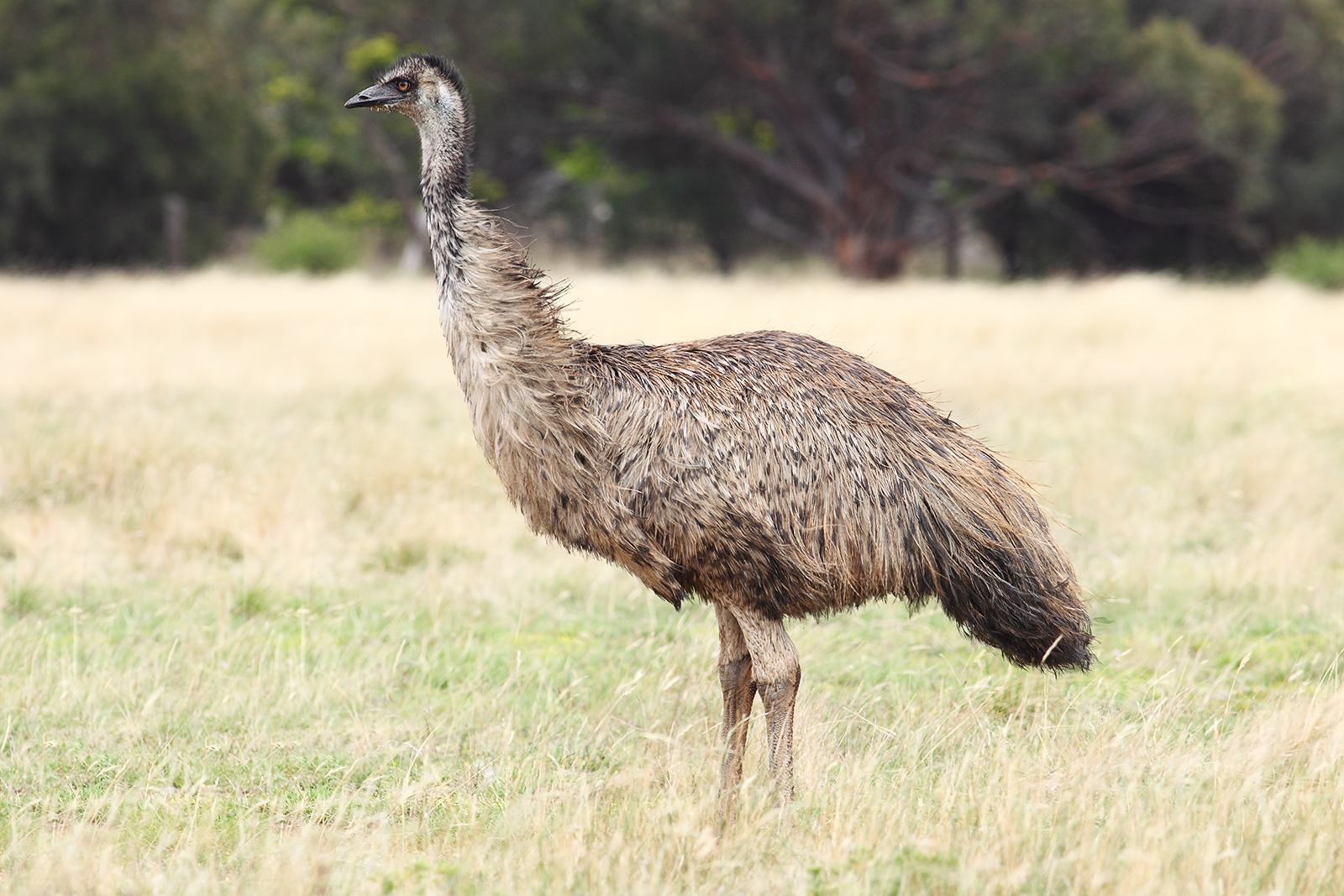
Dromaius novaehollandiae, a living example of the ever-successful ratite-like body plan common throughout archosaurs.
Presumably, Gargantuavis would've been slightly taller, but much thicker and more robustly built.
An animal like Gargantuavis from a Mesozoic ecosystem brings up a lot of questions on how it co-existed alongside its non-avian kin. Presumably, Gargantuavis filled a niche similar to what ornithomimids did in other Mesozoic ecosystems, perhaps with a slightly heavier reliance on plants. As far as I know ornithomimids have yet to be discovered from the entirety of Europe in the late Cretaceous, so it would make sense that Europe, which was a scattering of large islands at the time, would develop its own independent lineage of ratite-like animals. Gargantuavis lived on a fairly large chunk of late Cretaceous European archipelago, but it's interesting to note that other birds from different islands, like Balaur from Hatzeg, also became flightless. Perhaps a number of independent Mesozoic bird lineages became flightless on each isolated island environment? Would definitely like to see if more huge birds end up coming out of these deposits in the future.

All of this amounts of my final tidbit about this awesome animal, which ties-in a bit with the title... Why is there no good artwork of it? A quick Google Image search of this animal comes up with a whopping two illustrations. Just two. The first result is of Hyrotrioskjan's take, which is pretty great bar the fact it looks like a color-swapped ostrich with visible fingers. The next result is from a blog called Dino Detectives, and is worse, showing a full on naked arm similar to old dromaeosaurid reconstructions. That's all there is for Google's Gargantuavis results, and DeviantArt is barely any better.

Why has such an interesting animal been ignored by paleoartists? Balaur got a slew of paleoartwork done for it during both its first and second description, and Patagopteryx, an animal much smaller, simpler-looking, yet closely related to Gargantuavis, has a slew of artwork for it online. Don't think it has to do with its fragmentary nature either; Googling Amphicoelias or Sauroniops online should explain enough. The only other illustration outside of those that I've ever seen of Gargantuavis is in Martyniuk's 2012 book A Field Guide to Mesozoic Birds and other Winged Dinosaurs, in which he presents the best reconstruction I've yet seen of this animal. That leaves a total of three official reconstructions that I know about. (Let me know if you know of any more in the comments below.)

So, what does a dinosaur nerd like myself do when he's desperate to see more illustrations of what has to be one of the most interesting Mesozoic euornithines? Sharpen a pencil, pull out some sketch paper, and start drawing:

A trio of Gargantuavis and a juvenile Ampelosaurus wander through a crowded forest.
I blame my attempt at the complex environment on the Douglas Henderson illustration I've been looking at recently.
Above is a pencil sketch I hope to turn into a proper illustration sometime in the future. I'm far from an experienced artists, but I've recently been taking art classes which has greatly increased my skills. Given that Gargantuavis was a very large, heavily-built, herbivorous bird living in an environment filled with other big dinosaurs, I imagined this species living out its life rather like many species of lowland moa which we know from New Zealand. I imagine that in order to better protect themselves against big theropods, they may have avoided open habitats and preferred to live in denser forests where there are more areas to hide. Their more robust bodies and lack of any obvious cursorial traits might suggest that they were more stand-and-fight animals than skittish ones; and anyone who knows anything about ratities knows that these living giant birds can give quite devastating kicks and bites when provoked. Gargantuavis may have been the same if ever attacked by a dromaeosaur or other small theropod. I also included a young Ampelosaurus in the background, presumably either wandering into the forest from more open areas, or was born there and is currently waiting to reach the right size that it can then join a herd of animals.

And that's it for me. A lot of interesting extinct animals are definitely under-represented in artwork, and I feel it's our responsibility to try to not leave any of these wonderful creatures in the dust. I encourage fellow paleoartists to definitely check out Gargantuavis and other under-represented extinct animals when considering what your next piece will be. These guys deserve love just as more famous dinosaurs. Cheers!

Citation

Buffetaut, E. & Le Loeuff, J. (1998). "A new giant ground Bird from the Upper Cretaceous of southern France." Journal of the Geological Society, 155: 1-4.

Martyniuk, M. P. (2012). A Field Guide to Mesozoic Birds and other Winged Dinosaurs. Vernon, N.J: Pan Aves.

Weishampel, D.B.; Dodson, P. & Osmolska, H. (2004). The Dinosauria (2nd Edition). Berkeley: University of California Press. pp. 259–322, 588–593.

Tuesday, September 1, 2015

A Tale of Tails: The Evolution Driving Ankylosaur Tails & Armor

Peloroplites cedrimontanus, a nodosaurid from the Cedar Mountain Formation.
Image taken by yours truly at the USU Eastern Prehistoric Museum in Price, Utah.
Ankylosaurs are some of my favorite dinosaurs, which is saying a lot considering I love all dinosaurs pretty much the same. Perhaps it's the mental image of such a powerful tank of an animal walking across the landscape seemingly impervious to attack, or just my own personal connection to them through studying what we know of their internal and external workings. Either way, I'm hooked on these beasts and eagerly anticipate reading whatever I can on their biology, anatomy, and behaviors. I covered most of the reasons I love these animals in a video a while back, so I'll keep things rather focused in this post to some new stuff that's just come out.

Rewind back to a couple of years ago to SVP 2013 in Los Angeles. I attended the event and sat in a seminar by Victoria Arbour, in which she spoke of a study she was working on attempting to track the evolution of the ankylosaurid "tail club." Her results seemed to have concluded that ankylosaurids may have gone through something of a step system throughout the evolution of their tail club, gaining certain traits over roughly 40 million years. Fast-forward back to the present day, and it seems her paper just came out in the most recent Journal of Anatomy, coauthored by Philip Currie. Together they come up with some rather interesting new conclusions which has widespread impact on how we view the evolution of said tails in the group.

Arbour and Currie come to the conclusion that ankylosaurid tail clubs evolved in a series of evolutionary stages. These went from the long and flexible whip-like tails of the earliest ankylosaurs and ankylosaurids, to a number of early Cretaceous ankylosaurids which Arbour and Currie deem "bat-tailed," they name them so for having caudal vertebrae with lengthened prezygapophyses, which conjoin the vertebrae, while also lacking a tail club. Finally in the late Cretaceous appear derived, so-called "club-tailed" ankylosaurids, which possess both lengthened prezygapophyses and dramatically enlarged osteoderms forming the so-called tail club. I prefer calling these ankylosaurids "mace-tailed" personally, as club is something of a highly generalized term that encompasses a lot of very different types of weapons, but that isn't really important. What is important is finding out what all this means about ankylosaur biology. Can learning how they evolved tell us how these tails were used?

Non-ankylosaurid ankylosaurs might provide some help. Polacanthids (or simply just polacanthinae, depending upon whom you ask) had long flexible tails without any extreme specializations with one exception: Some polacanthid species, such as Gastonia burgei, had extremely large and ominous-looking osteoderms along the sides of an otherwise flexible tail, leading to suggestions that they might be used in defense. The documentary series Jurassic Fight Club (also called Dinosaur Secrets for those of you in the UK) went so far as to call this form of armor a "prehistoric chainsaw," and although this might seem over-the-top, the tails of these ankylosaurs do remind me of a certain TV Tropes weapon. (I have more to say about JFC in a future post.)

Gastonia burgei, also from the Cedar Mountain Formation, but part of the earlier Yellow Cat Member.
Skeletal by Gregory S. Paul from his book The Princeton Field Guide to Dinosaurs.
Nodosaurids, on the other hand, tended to have much simpler tails. Examples like Sauropelta and Edmontonia both possess either simple tiny osteoderms down the tail, or no osteoderms at all. The tails were, however, extremely long and whip-like, and could've still been used to give a predator a good whack to the face when necessary. It's interesting to note, however, that many nodosaurids do possess extensive armor plating on and around the head and front of the torso. Perhaps this suggests that nodosaurids were much more head-on than other ankylosaurids with their defensive approach. Edmontonia especially has forward-projecting shoulder spines which are bifurcated like deer antler, which has led to the suggestion that it is some form of weapon that could be used to charge predators or lock with rivals.

But what about ankylosaurids proper? Why take the first step towards "bat-tailed" forms with tightly-locked tail vertebrae? Sexual selection might actually play something of a role here. A "bat-like" tail of fused vertebrae delivers more force than a whip does, so the development of a more robust and immobile tail might help in sparring matches where two ankylosaurids line up side-by-side to smack each others flanks. This kind of behavior would then eventually lead to the evolution of thicker and sturdier tails, and would also encourage the evolution of the tail club. The same idea has also been suggested for South American glyptodonts and ancient meiolaniid turtles, which are also coincidentally huge, well-armored herbivores with wide girths and extensive osteoderm coverings. Perhaps this kind of competitive behavior is something which develops uniquely with this type of body design.

Or we could go with the more traditional view of a defensive evolutionary drive for the evolution of tail clubs. In this view, earlier ankylosaurids first developed the elongate prezygapophyses in order to create a more active and dynamic form of defense against predators outside of the possibly more sit-and-wait strategies of other ankylosaurs. The "bat-tails" could be used as a whacking weapon to smack at the heads and legs of hungry theropods, or to sound more awesome, to slice them up. Note that although the club part had yet to evolve, some earlier ankylosaurids had smaller osteoderms on these so-called "bat-tails." Gobisaurus possessed a "bat-tail" with elongate prezygapophyses and no enlarged tail club made of osteoderms, but it did seem to possess decent-sized smaller osteoderms along either side of the tail like Gastonia. This means it had a robust, bat-like tail, with bladed sides. Perhaps ankylosaurids like it should be dubbed "sword-tailed" or "tebutje-tailed." Of course, neither idea directly debunks the other, and multiple purposes for such a structure seems entirely likely.


A tebutje, a Polynesian form of war club with bladed edges.
Kinda like basal ankylosaurid tails, although this one's made out of shark teeth.
In the latest Cretaceous, true club- (or mace)-tailed ankylosaurids appeared, and they immediately took off with hugely varied designs for the club. The earliest ankylosaurid with a big knob at its tail tip is Pinacosaurus (or possibly Talarurus) which had a rather modest-sized tail club, and from humble beginings we get whole variety of designs ranging from the abnormally narrow knob of Dyoplosaurus, to the abnormally massive and robust tail knob of Ankylosaurus, and even the extremely massive and pointy knob of Anodontosaurus. All-in-all, this wide variety of tail clubs suggests something else: Could they have each been used in different ways? I personally think so. Having a massive, heavy tail club at the end of your tail is extremely powerful to possess, but it can be cumbersome to "wield," and because of its weight, rather slow to swing. On the other hand, having a smaller tail club is much easier and faster to swing, but against some rather large predators might be lacking in sufficient strength to do any significant damage.

Could the types of predators and their behaviors in a given ecosystem have influenced the development of these clubs? Well, some ankylosaurids with smaller knobbed tail tips, such as Pinacosaurus, seemed to live in an environment where smaller dromaeosaurids were the most common form of predator. Paul even suggested in his book The Princeton Field Guide to Dinosaurs that, with its smaller tail club and lighter build, Pinacosaurus could easily hit and threaten all kinds of smaller predators. On the other end of the spectrum, a number of ankylosaurids with truly massive tail clubs were contemporaries of massive tyrannosaurids, in which even larger and more powerful knobs (the ones required to break a rex's ankles) were required.  This is just me delving into some speculative science though, and I don't know if anyone else has found any such correlation. Might be something interesting to look into.

And I think I'll stop there. Ankylosaurs are definitely a very interesting bunch of animals, and I will be sure to discuss them again in the future. If you want more ankylosaur-goodness though, I recommend checking up on Victoria Arbour's blog Pseudoplocephalus. She has a great post out now on her new study, so make sure to read that, too. Cheers!

Citation

Arbour, V. M. and Currie, P. J. (2015), Ankylosaurid dinosaur tail clubs evolved through stepwise acquisition of key features. Journal of Anatomy. doi: 10.1111/joa.12363

Paul, G.S., 2010, The Princeton Field Guide to Dinosaurs, Princeton University Press p. 232

Tuesday, July 21, 2015

The Good-er Dinosaur


Well then, just when one over-hyped dinosaur film comes out, another one takes its place. Seriously, 2015 is looking like the year of the dinosaur. Not just that, but it also happens to be the second Pixar film this year, a first for the studio. Guess people like me who appreciate dinosaurs and good animation just got super lucky.

While I personally was not a big fan of Jurassic World for a number of reasons (not just the inaccuracies, mind you), I've been keeping an eye on this film for quite a while. I still remember first hearing about it back in 2011, and listening in on-and-off about how production was doing and who and what was attached. The promotional artwork certainly looked promising, and the concept for the film was rather interesting. Tied to it all was also the fact that Greg Dykstra is involved, the sculptor for a number of Pixar and other animation projects ranging from Finding Nemo to The Nightmare Before Christmas. He also happens to be a big dinosaur-nerd, and has been out on digs in South Dakota while much of the production of The Good Dinosaur was getting started. Now that some trailers of the film have finally appeared, I think it's definitely a better time than any to start talking about it.

Some early concept art of the film. Arlo, the Apatosaurus lead character, seems to have gone from a full-sized sauropod to a juvenile during production. Spot doesn't seem to have changed much at all.
The movie is based on the concept of a major "what if" question. "What if" the asteroid impact that occurred 66 million years ago, missed? And thus, the K-T extinction event didn't occur? Dinosaurs would still be wandering the Earth, and much of our fauna would probably be much more like the Mesozoic. The plot centers around Arlo, a juvenile Apatosaurus who's part of a small herd that lives in the "Clawed-Tooth Mountains". One day, a tragic event occurs which kills Arlo's father and causes the young sauropod to fall into a river, where he is hit by a rock and knocked unconscious. Upon awakening, he finds himself far away from home and needs to find a way to make it back. While searching, he stumbles upon a young human boy, who like him, also seems to be all alone, if not lost himself. Arlo names the human Spot, and the two set off on a journey back to the Mountains, encountering a wide range of landscapes and colorful characters along the way.

Many people into speculative biology and evolution already know many examples of the main premise of this in fiction already. The idea of dinosaurs never going extinct has been used by Dougal Dixon's The New Dinosaurs, the Speculative Dinosaur Project, and as a host of other independent projects online. This is a Pixar-ized version, however, and while there appears to be a form of worldbuilding and perhaps a few speculative creatures (the heck is that red snake-lizard thing?!), this is mostly fantasy. It also strangely seems to be an homage to many old-school dinosaur films, with the opening from the two trailers obviously being an homage to the Rite of Spring segment in Disney's Fantasia. The film also seems to take a twist on those old cartoons where there's a caveman and his pet Apatosaurus/Brontosaurus: the symbiosis is present, but reversed, with Arlo apparently treating Spot like a pet.

Who doesn't like to flaunt their animation budget every now and then?

I'll be holding most of my judgement for when the film actually enters theaters, but from the looks of the trailers, it is gorgeous. Holy crap, when the first teaser trailer came out I was debating with myself whether or not the animals were placed over a real backdrop, but nope, everything is CGI. Greg Dykstra and the rest of the animation department have my permission to pat themselves on the back and throw a party. This is some of, if not THE best animation I think I've ever seen from a Pixar film, and this is just from the first trailer. Everyone remember when the first Jurassic World trailer came out and how bad everyone thought the CGI was? If this is how the movie looks now, at only the first trailer, the final product is gonna be brilliant.

I won't talk about inaccuracies, as a) the dinosaurs are meant to be anthropomorphized, cartoony, and human-like, and b) we've yet to see most of the characters from the film from what I've heard, but I'll go over a few things I noticed from the trailer that caught my interest...
  • The Opening - The opening scene where the asteroid whizzes overhead is obviously using pre-dinosaur renaissance dinosaurs in it. Although, as said before, this seems to be a reference to Fantasia if anything, so I'm willing to let it slide.
  • Arlo's Legs - Other than the typical "sauropods didn't have elephant-feet" point, why does he have backwards "elbows"? Granted, they could be elongate "hands" and the upper arm could be embedded in the body, but it's still weird and makes his legs more horse-like than anything. And it doesn't help that he gallops...
  • Galloping - Can sauropods even gallop? I don't think they can...
  • Old Cross-Eye - The heck is that ceratopsian supposed to be? Looks like an asymmetrical Styracosaurus with extra spikes and Triceratops brow horns. Guess it could be a new species that evolved in the past 66 million years, but then why is Arlo's species still Apatosaurus after an even longer period of time?
  • The Riders - If you look close at the cross-eyed ceratopsian's head, you'll see there's a large number of small animals sitting on it, ranging from monkey-like things, to armadillo-like things, to some owls, an anole, and quite a few birds. Two of these birds are rather odd, and look almost like Rahonavis or some small dromaeosaurid. It's hard to tell if they actually are, but it might suggest we're getting properly feathered maniraptorans in this film.
  • Red Snake-Lizard - I said it before and I'll say it again. The heck is that thing?
  • Bat-Crap Crazy Pterosaurs - Why do pterosaurs always have to be eagle-swooping bringers of death? Not even in Pixar can they be cute adorable things that sing. I want a cute trio of fluffy Darwinopterus to sing to our heroes, not toothed Pteranodon (faceplam) to swoop down and pick up humans with opposable feet that they don't have!
Anyways, despite some of the issues, I'm still hyped and can't wait. I adored Inside Out, and I'm looking to see what Pixar brings to the table next. This will probably not be the last time I bring up this movie, so stay tuned for more. Cheers!

Sunday, July 12, 2015

Harley's Head and His Leaf-Munching Neighbors

Image of bad Iphone camera quality, but with dinosaurs.
Here's that head of Harley (LACM 23844) I promised. The biggest tyrannosaur in LANHM's collection, Harley's a monster with a five foot head and some terrifying teeth, the longest of which is nearly twelve inches. When he was first put up on display, Harley was the largest T. rex (and indeed, theropod skull period) on display anywhere in the world, and it still quite a sight to behold.

During my time working at the Los Angeles Natural History Museum, I've gotten a ton of questions relating to this skull and our other Tyrannosaurus from people glancing at it through it's display case. One of the most-asked questions I've got actually has to do with what isn't present in this mount. If you notice at the bottom of the picture, Harley's jaws are separate and not touching. This has lead to a lot of questions and suggestions from visitors that Tyrannosaurus was able to separate it's jaws out like a snake in order to swallow huge prey items.

Alas, that's not the case. Harley's jaw tip was simply not recovered during the expeditions to free him in the 1960s. Other Tyrannosaurus with complete lower jaws show such fusion between the two lower mandibles (take this image of Stan, for example). I don't see why T. rex would need to swallow massive prey items anyways. When you've got a bone-crushing bite and the power to rip chunks of bite-sized meat off prey, flexible snake-like jaws become a hindrance that I'd expect would actually weaken the overall crushing ability.

Oh yeah, and next to Harley is his neighbor, LACM 154919, a Lambeosaurus lambei. At just a little bit over two feet long, this skull has hardly any of the massive overpowering presence that Harley's skull does, and doesn't get nearly as many family pictures in front of it. It's a shame really, especially given the size of the actual animal it probably came from. We do have some other ornithischian dinosaurs with a more overpowering presence, however...


More bad Iphone camera quality, with a dinosaur.
And this is our big Triceratops prorsus (LACM 59049) skull, again. Like Harley, we decapitated this dinosaur for safety reasons, and it's head is safe in a glass case alongside two other ceratopsid skulls (which will be shown in the future). The head on the mount is a lightweight cast built to be lightweight and replaceable, which is good considering this induvidual had a skull over eight feet long (if not longer). LACM 59049 was also one of the more complete specimens of its kind during it's initial discovery. 60% of this Trike's bones were discovered over the course of a couple of field seasons, and most of those bones are on display throughout the institution; abet scattered.

You can tell that this specimen is a T. prorsus, and not a T. horridus, by the enlarged nasal horn. T. horridus has a little stub of a nasal horn on its head, but longer (proportionality speaking) brow horns than T. prorsus. Work done by
Scannella and Fowler (2009) suggests that these two species were separated stratigraphically in the Hell Creek and other similar formations, with horridus specimens appearing in older rocks and prorsus occurring closer to the K-T boundary. Some specimens of Triceratops found in the middle of the Hell Creek even show evidence of being intermediate between horridus and prorsus, suggesting that horridus directly evolved into prorsus, which would be incredibly cool if shown true.

Expect more ceratopsians soon...
__________________________________________________________________________________


- Scannella, J.B. and Fowler, D.W. (2009). "Anagenesis in Triceratops: evidence from a newly resolved stratigraphic framework for the Hell Creek Formation." Pp. 148–149 in 9th North American Paleontological Convention Abstracts. Cincinnati Museum Center Scientific Contributions 3.

Friday, July 10, 2015

A New Beginning...

Hello and welcome dear readers to my humble abode. This is my starting post to a blog that will hopefully turn out to be a good permanent residence for my writings and rambles. What are the topics of these writings gonna be? Mostly extinct animals and paleontology in general, I hope, but I also plan to use this blog to write about quite a bit more than that. I have many interests covering a wide range of topics, and because of that, I hope to use this blog to talk a whole range of things that I, and I hope readers, finds interesting.

First thing's first though: disclaimers. Although I will be writing about dinosaur-themed topics as well as various other interests of mine, I want to make clear that I'm simply an enthusiast, and not a actual paleontologist with any form of degree. I have a volunteer job at the Los Angeles Natural History Museum where I work as an educational docent, have taken classes on paleontology and geology, and have published writings in online magazines, but everything posted here doesn't come from an "expert". Just someone who loves to learn, and loves sharing what he has learned with others. If you want to read from actual experts, there's plenty of other blogs out there that can fulfill your wishes, such as TetZoo, SV:POW, and Mark Witton's Blogspot.

I hope to use this blog to introduce people to new ways of looking at science. Whether it be hard factual discoveries that shape the way we perceive the past, to speculative sciences that allow people to see things they find familiar in a new light. This is a place to educate those who know little, while also enriching the experiences of those that know much.

As such, this is also a blog that will openly take requests if people wish to learn more. I will be sure to take the time to read every post made here, and if anyone wishes to pass me a question, either here, on Facebook, or some other form of media, I'll try my best to answer it.

And with that, I thank you all for joining me at my new location. I'll leave you all with a rather popular picture of the LA Natural History Museum's famous mount of a Triceratops prorsus (LACM 59049) and Tyrannosaurus rex (LACM 23844).

Picture by yours truly, with shameful iPhone quality to boot.

We at the museum call this T. rex Harley, after the late Harley Garbani who discovered most of our institution's Tyrannosaurus. When he was unearthed in the late 1960s, his bones were disarticulated and scattered, and most of the body was missing; but the head was largely complete. It was so complete, in fact, that Harley (the dinosaur) held the title of the most complete T. rex skull of in the world for a long time. That is, until more complete Tyrannosaurus like Sue (FMNH PR 2081) beat him out in the late 1990s. That head, however, isn't displayed on this mount. The head shown is a lightweight cast, built to be replaceable in case it ever falls due to California's infamous earthquakes or other disasters. His real, concrete-filled skull is in a well-protected display case in our Dinosaur Hall.

Pictures of that will be coming soon! Cheers! :)